



Blog
Sunstone: August’s Fire Stone for Leo’s Exit, Virgo’s Entrance

There is something unmistakably electric about the entire month of August. The air still hums with summer's warmth, but if you listen closely, you can feel the subtle shift—a quiet invitation to gather what you've grown and prepare for the season ahead. In the world of crystals, one stone captures this exact frequency better than any other: Sunstone.
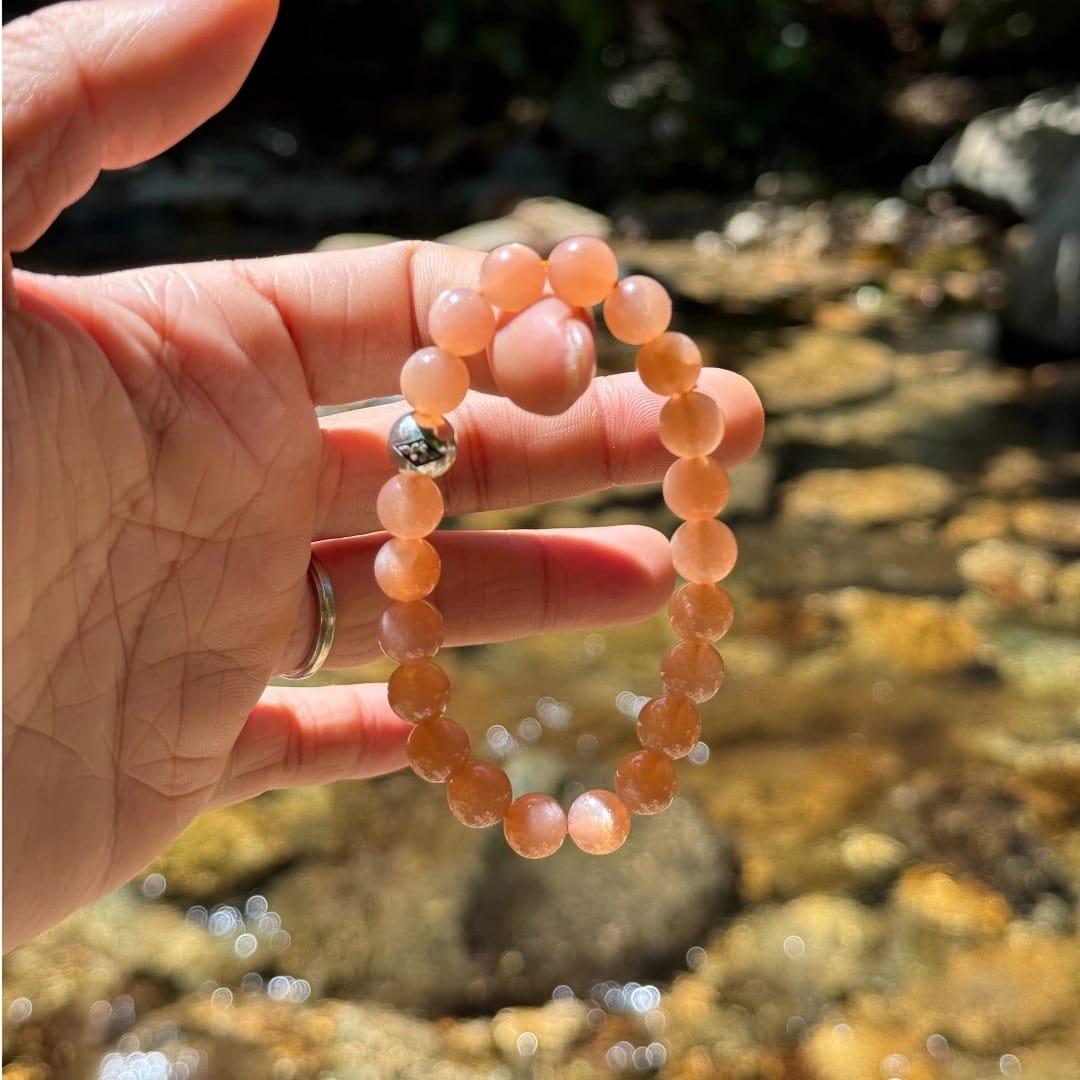
Sunstone has earned its own devoted following as a late-summer powerhouse. With its signature schiller effect—those tiny copper or hematite inclusions that flash like trapped sunlight every time you turn your wrist—Sunstone doesn't just sit pretty. It radiates. It activates. It reminds you, quite literally every time the light hits it, that your inner fire is not a resource you can run out of. It's renewable.
At AURATARA, our Sunstone Bracelet | Growth · Health · Passion, is crafted from natural feldspar, polished into smooth that catch the light from every angle. But this article isn't about the product. It's about the stone—its history, its energy, how to work with it during the most pivotal astrological transition of the year, and why wearing it on your wrist might just change the way you show up for the rest of 2026.
The Geological Story: Born of Fire, Polished by Time
Sunstone belongs to the feldspar family, the same mineral group that gives us moonstone and labradorite. Feldspar is actually the most abundant mineral group in the Earth's crust, making up roughly 60% of exposed rock. But Sunstone is anything but ordinary.
What makes Sunstone unique is its inclusions—microscopic platelets of copper, goethite, or hematite that align within the crystal lattice during formation. When light strikes these platelets at the right angle, it reflects back in a warm, golden-orange shimmer known as aventurescence or schiller. The visual effect is uncanny: it looks exactly like sunlight fractured and frozen inside a stone. The name "aventurescence" itself comes from the French word aventure, meaning "chance" or "fortune"—a nod to the lucky accident of discovering this glittering effect in the first place.
Most commercially available Sunstone comes from three primary sources. Oregon (USA) produces the most coveted variety, with some specimens containing actual native copper inclusions that give them a deeper red-orange flash. These Oregon Sunstones were designated the official state gemstone in 1987. Norway's Sunstone—historically called "Heliolite" by the Vikings—has a paler, more diffused glow with reddish sparks. Indian Sunstone tends to be the most accessible, with warm peach-to-terracotta tones that make it a favorite for everyday jewelry.
What's fascinating from an energetic standpoint is that Sunstone forms in basaltic lava flows. It is, quite literally, a piece of cooled volcanic fire that you can wear on your body. This geological origin is precisely why it resonates so powerfully with Leo season's closing days and the impending shift into Virgo. It carries the memory of earth's raw creative force, cooled and stabilized, ready to be worked with consciously.
Cultural History: From Viking Navigators to Oregon's State Stone
Long before modern crystal healing, Sunstone had a reputation as a navigational and protective tool. Norse sagas describe Viking sailors using a "sólarsteinn" (sun stone) to locate the sun's position on overcast days—a practice that some researchers believe referred to Iceland spar or the light-polarizing ability of certain feldspars. Whether myth or maritime fact, the association stuck: Sunstone as a guide when the path isn't clear.
In Norse mythology, the sun was personified by the goddess Sól, who rode across the sky in a chariot pursued by the wolf Sköll. The story goes that Sól would occasionally fling pieces of the sun down to Earth to help lost travelers find their way. Those pieces became Sunstone. Whether you take this literally or symbolically, the metaphor holds: when you feel lost in late August—unsure whether to hold onto summer or surrender to fall—Sunstone is the piece of the sun you can hold in your palm.
In 1987, Oregon designated Sunstone as its official state gemstone, recognizing both its geological significance and the fact that it occurs naturally nowhere else in the United States with such clarity and copper-based color play. For Native American tribes in the Pacific Northwest, including the Paiute people, Sunstone was considered a sacred stone of vision and prophecy, often carried by healers and seers during vision quests.
In India, Sunstone has been used in Ayurvedic traditions for centuries, associated with the manipura (solar plexus) and believed to stimulate the digestive fire—both literal metabolism and the metaphorical "fire in the belly" that drives purposeful action.
This rich cultural lineage means Sunstone carries a layered archetypal energy: the explorer's compass, the healer's sight, the leader's crown, and the sun goddess's gift—all compressed into a single warm, glowing bead.
Chakra Alignment: Solar Plexus Meets Sacral
Energetically, Sunstone is most commonly associated with two chakra centers.
Solar Plexus Chakra (Manipura): This is Sunstone's primary home. Located just above the navel, Manipura governs personal power, self-confidence, digestion, and the ability to translate intention into action. When this center is balanced, you feel motivated, decisive, and capable. You trust your gut—literally and figuratively. When it's blocked, you might experience procrastination, indecision, low self-esteem, or digestive discomfort. Sunstone's warm, activating frequency directly feeds this center, like adding kindling to a fire that's gone quiet.
Sacral Chakra (Svadhisthana): Secondary activation happens here, just below the navel. Svadhisthana rules creativity, passion, pleasure, and emotional flow. Sunstone's orange-gold frequency gently stimulates this area, making it an excellent stone for artists, entrepreneurs, or anyone feeling creatively stuck after a long summer lull. It reminds you that joy is not a luxury—it's fuel.
During late August, when Leo's solar dominance begins to wane and Virgo's earthy discernment takes over, Sunstone acts as a bridge. It says: keep your fire, but learn to aim it with precision. This is why it's such a perfect stone for the Leo-to-Virgo transition—it honors where you've been (bold, expressive, radiant) while preparing you for where you're going (organized, intentional, service-oriented).
Zodiac Connections: Leo's Farewell and Virgo's Welcome
Leo season runs from approximately July 23 to August 22. It's ruled by the Sun—no surprise there. Sunstone, with its solar resonance, is practically a Leo talisman. For those born under this sign, wearing Sunstone during their birthday month amplifies everything Leo does best: generous leadership, creative self-expression, warmth, and an unshakable sense of self. It's like turning the volume up on your natural gifts.
But here's where it gets interesting for the rest of us: you don't have to be a Leo to benefit. As we move toward Virgo season (starting August 23), Sunstone offers non-Leos a way to carry forward the confidence and visibility that Leo season awakened—without burning out. Virgo energy can sometimes tip into self-criticism or hyper-focus on flaws. Sunstone's sunny disposition acts as a buffer, reminding you that your worth isn't determined by your productivity or your perfection.
For Virgos themselves, Sunstone provides a much-needed dose of warmth and self-acceptance. It softens the sign's tendency toward perfectionism and infuses the analytical mind with optimism. Think of it as a gentle sunrise after a long, dark night of editing your own life.
How to Work with Sunstone: Practical Rituals for Late August
Daily Wear
Slip your AURATARA Sunstone bracelet onto your left wrist in the morning to receive its energizing, confidence-building frequency throughout the day. The left side of the body is traditionally considered the receiving side in energy work. If you're heading into a situation that requires you to project authority—a presentation, a negotiation, a performance review—you can also wear it on your right wrist, the giving or projecting hand, to broadcast that solar confidence outward.
Desk Placement for Back-to-School and Back-to-Work
As millions of students and professionals re-enter structured routines in August, Sunstone earns its place on your workspace. Place your bracelet or loose Sunstone beads in the southeast corner of your desk. In Westernized Feng Shui for the home or office, the southeast corresponds to the Wealth and Abundance area (Xun gua). Sunstone's fire energy here fuels motivation, attracts opportunities, and keeps your momentum strong through the transition from summer freedom to fall responsibility.
Morning Meditation
Hold your Sunstone bracelet in both hands during a five-minute morning meditation. Close your eyes and visualize a warm golden light expanding from your solar plexus, filling your entire torso, then radiating outward through your skin. With each inhale, imagine you're breathing in sunlight. With each exhale, release any heaviness or self-doubt you've been carrying. Repeat this affirmation three times: "I am a source of my own light. My energy is renewable. I step into this new season with clarity, warmth, and purpose."
Full Moon Charging During the August Sturgeon Moon
The full moon in August 2026 falls on August 27—right as Virgo season is kicking in. This is known as the Sturgeon Moon in North American tradition, named by the Algonquin people for the abundant sturgeon fish harvested in the Great Lakes during this time. While Sunstone is a solar stone and loves brief morning sunlight, the full moon offers a complementary feminine recharge. Place your bracelet on a windowsill overnight on August 26–27 to bathe it in lunar energy. This balances the stone's fiery nature with intuitive, receptive energy—perfect preparation for Virgo's detail-oriented, service-driven weeks ahead.

Cleansing and Care
Sunstone is relatively durable (Mohs hardness 6–6.5), but mindful care preserves both its beauty and its energy:
Avoid prolonged water soaking.
Quick rinses are fine, but don't leave it in a bowl of water overnight. Feldspar is somewhat porous and can eventually absorb moisture, leading to a cloudy appearance.
Morning sunlight for charging.
Five to ten minutes of direct morning sun once a month is plenty. Avoid harsh midday summer sun, which can fade the color over time.
Selenite plate resting.
Place your bracelet on a selenite slab overnight for a gentle, dry cleanse that won't damage the elastic cord or the stone's surface.
Smoke cleansing.
Pass through white sage, palo santo, or frankincense smoke while setting an intention to clear stagnant energy.
How to Work with Sunstone: Practical Rituals for Late August
While Sunstone is powerful on its own, pairing it intentionally with other stones in your AURATARA collection creates beautiful synergy:

Sunstone + Yellow Tiger's Eye:
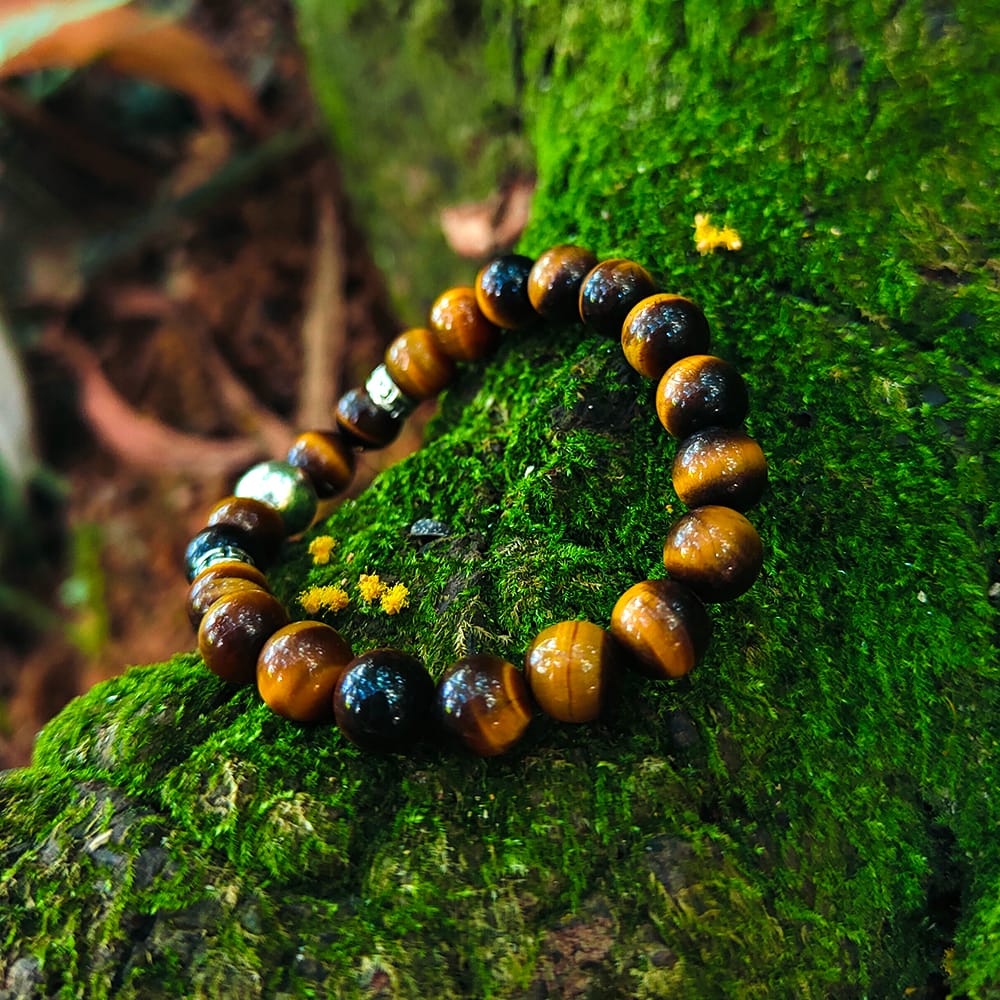
Double solar plexus activation. Confidence meets focused action. Ideal for launching a new project or tackling a daunting to-do list in late August.
Sunstone + Rose Quartz:
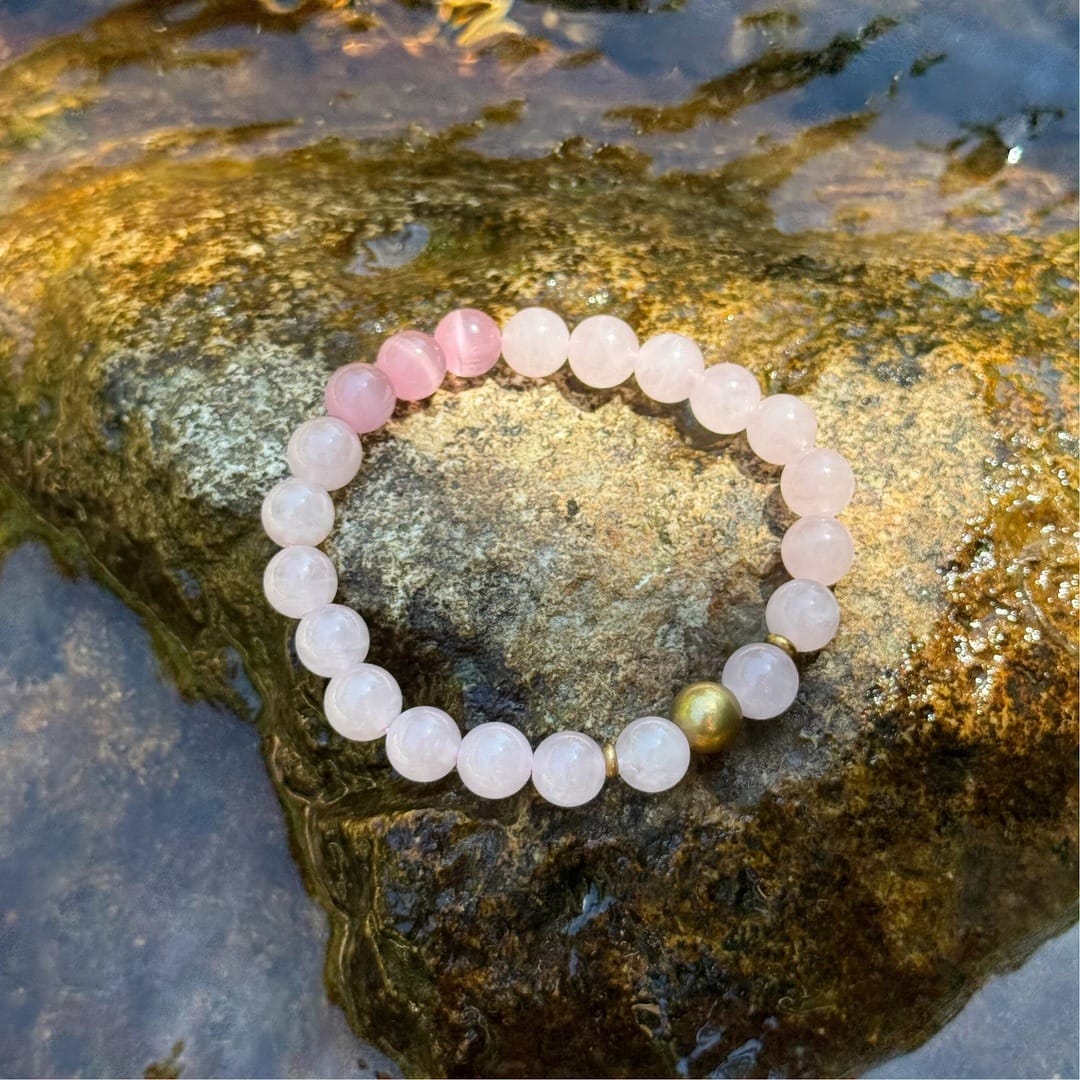
Fire meets heart. This pairing ensures your ambition stays rooted in kindness—both toward yourself and others. Prevents the "hustle until you break" trap.
Sunstone + Amethyst:
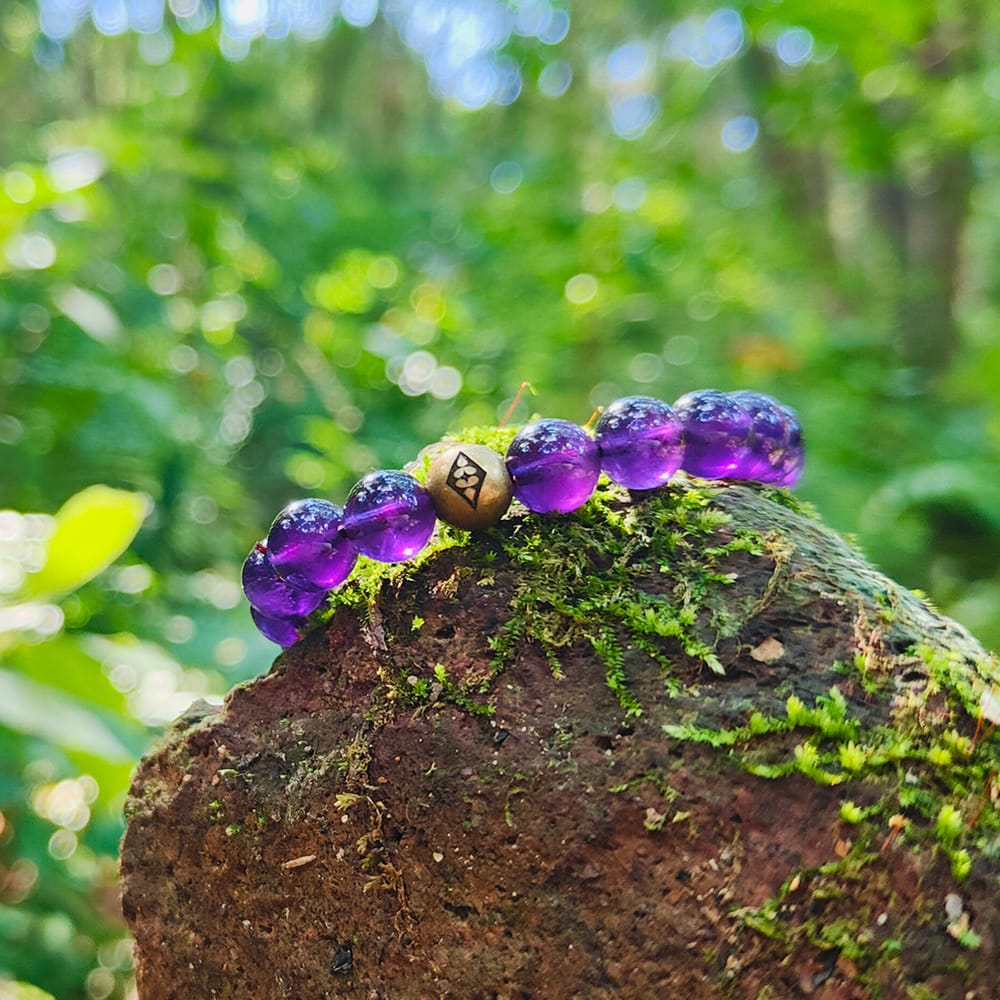
Energizing yet calming. Sunstone gets you moving; Amethyst keeps your nervous system regulated while you do it. Perfect for high-pressure weeks.
Sunstone + Red Tiger's Eye:
Radiant action plus grounded protection. This is a powerhouse combo for anyone stepping into a leadership role this fall.
Frequently Asked Questions
Q: Can I wear Sunstone every day?
A: Absolutely. Sunstone is durable enough for daily wear, and its warm, uplifting energy makes it an excellent everyday companion. Just remove it before heavy lifting or contact sports to protect the elastic cord.
Q: Will Sunstone fade in sunlight?
A: Like most colored gemstones, prolonged exposure to intense direct sunlight can cause gradual fading. Brief morning sun for charging is safe and beneficial; all-day direct sun—especially through a hot car window—is not recommended.
Q: Is Sunstone the same as Goldstone?
A: No. Goldstone is a man-made glass with copper flecks suspended in it. Sunstone is a natural feldspar mineral. AURATARA uses only genuine natural Sunstone in our bracelets.
Q: Which wrist should I wear Sunstone on?
A: Left wrist to receive its energy (confidence, vitality, warmth). Right wrist to project it outward (leadership, visibility, creative expression). Many people switch depending on the day's intention.